Origins and info. on Hedgehogs |
||
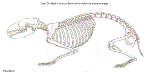
Where did the Hedgehog come from? The Hedgehog comes from an ancient family and fossils suggest that Hedgehog-like creatures have been on the earth for about 15 million years. Fossils found suggest that hedgehogs haven't changed much in all these millions of years. Has it any relations? The modern Hedgehog has no close relatives amongst other mammals although it may have distant links with moles and shrews. It belongs to a family all on its own and has developed along a separate evolutionary line for millions of years. The family has a dozen or so species, five in S.E. Asia, three in Africa and two in China but no indigenous ones in the Americas or in Australasia. Our British Hedgehog is the same species which occurs in most of the continent of Europe and is called Erinaceus europaeus. What does a Hedgehog look like? Of course the Hedgehog is characterised by its spines or quills. These are modified hairs, which are durable on the outside, while being filled with air pockets on the inside about 2-3cms (1") long, which cover the back of its head and body. As a Hedgehog grows the number of its spines increases until when adult it has between 5000 and 6500. By this time it's body will be somewhere between 15-25cms (5.9-9.8 inches) in length but its tail will be less than 2-3cms long. Under the prickles the Hedgehog has a remarkable system of muscles which are designed to raise and lower its spines. When it is frightened it will tighten the muscles around its flanks and curl up. Its soft parts are thus completely guarded by a defensive cover of prickles which few enemies can penetrate. But what about its bones? Have a look at the diagram of a Hedgehog's skeleton below -
Scientists have discovered very little unusual about the Hedgehog's skeleton except the shortness of the neck. This probably helps it to roll up into a compact ball more easily. The Hedgehog's peculiar ability to roll itself into a ball, and to stay in this attitude for a long time (especially during hibernation), however, is made possible by the powerful muscle which covers its back like a cape. A look at the X-ray picture of a rolled up Hedgehog below will make it clear why this self-defence mechanism means that it has fewer enemies than any other mammal of similar proportions.
|
More Facts about Hedgehogs: They have relatively long legs for their body - and these enable them to run as fast as we can walk. Their front feet are shorter and broader than their back ones. The claws on their powerful front feet are particularly useful for digging. Each night Hedgehogs in the wild will probably make a slow and apparently haphazard search for food and will travel between 2-3kms (1-2 miles). They have small bright eyes but cannot see very well. At night they will use their excellent sense of smell and hearing to guide them. Their weight will be largely determined by the food they get, but most one-year olds will weigh between 450-680g (1-1½1bs). Self-anointing is an activity only Hedgehogs do. It seems to be connected with strange smells or tastes which cause them to produce large quantities of frothy saliva. They then spread the foam over their spines by flicking it with their tongue. A young Hedgehog can expect to live for 4 to 6 years. By this time it will be getting old but might live to the age of ten in captivity. Generally they lead solitary lives and tend to go out of their way to avoid other Hedgehogs, except during the mating season. Like most mammals the Hedgehog has a characteristic smell and this will usually warn other Hedgehogs to keep out of the way. Humans can't smell this smell. Hedgehogs do not smell bad. Their urine and feces have no smell unlike rodents or small animals. They also don't have visible male genitals like testicles which can be a turnoff to some owners of hamsters and rats. In the mating season the male may be attracted by the different smell of the female and commence a rather prolonged and noisy courtship with her. Again, humans cannot smell this. Hedgehogs do not pair bond and the female raises her young unaided by the male. Litters of young called Hoglets, average about 3 to 5 in number. When the Hoglets are about 5-6 weeks old they leave the nest and wander off on their own - eating solid food, drinking water and using a wheel. Domesticated species prefer a warm climate (above 22 °C , 72 °F) and do not naturally hibernate. Attempts to hibernate due to lowered body temperatures can be fatal, but are easily reversed if caught quickly (within a few days). In the wild they eat a diet of mainly insects. Their spines are not poisonus or barbed and, unlike the quills of a porcupine, cannot easily be removed from the hedgehog. However, spines normally come out when a hedgehog sheds baby spines and replaces them with adult spines. This is called "quilling." When under extreme stress or during sickness, a hedgehog can also lose spines.
info. adapted from: usgs.wildlifeinformation.org |
|

This free website was made using Yola.
No HTML skills required. Build your website in minutes.
Go to www.yola.com and sign up today!
Make a free website with Yola
